
How Laser Cutting Works: Making a Layered Wooden Lamp, Step by Step
A laser cutter burns a line as fine as a hair through wood. Here is how that becomes a glowing, layered lamp, and what the laser cannot do.
Key facts
- Laser cutting uses a focused beam of light to burn or vaporise a very narrow line through a material, guided by a digital design.
- On wood, the laser leaves a slightly darkened (caramelised) edge, which glows attractively when a lamp is lit.
- A layered lamp is several thin cut panels stacked with small gaps, so the scene has depth and casts shadows.
- The laser only cuts; sanding, finishing, assembly and quality checks are done by hand.
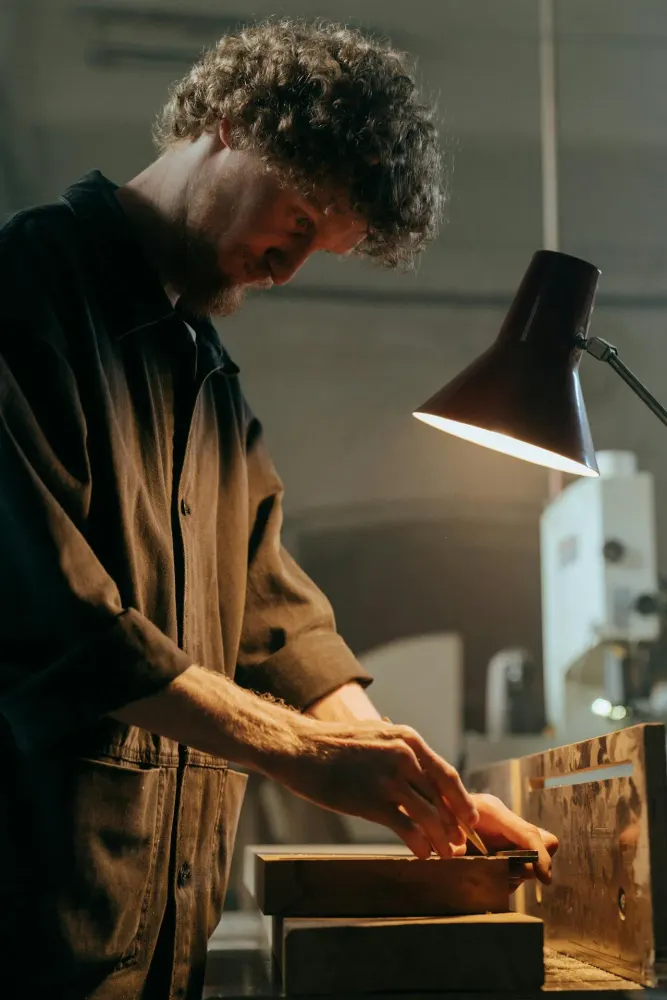
How does a laser cutter work?
A laser cutter focuses a powerful beam of light onto a tiny spot. On wood, that spot heats so quickly that the material burns away along the path, leaving a cut a fraction of a millimetre wide. The machine moves the beam (or the bed) along the lines of a vector drawing, so it can follow curves and corners no hand saw could.
Two settings matter most: power and speed. Too much power chars the edge; too little leaves the cut incomplete. Getting them right for each sheet of natural wood, which varies in density, is part of the craft.
Why do laser-cut edges look dark?
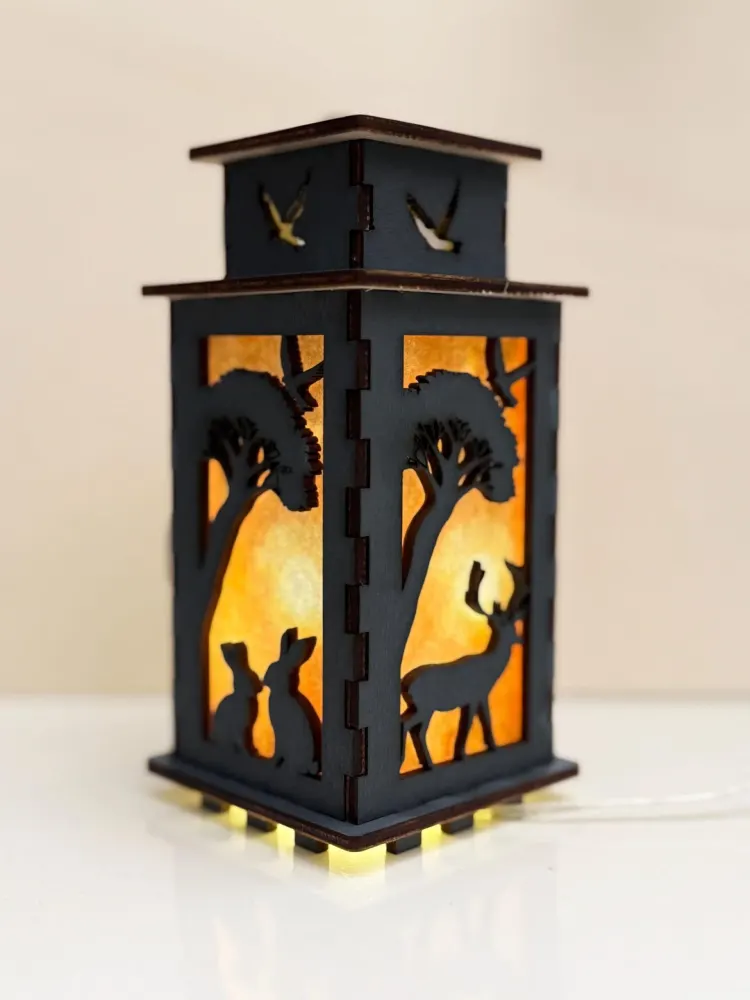
The heat of the beam lightly chars the cut edge, giving it a darker, caramel colour. Some makers sand it all away; we keep a little, because when the LED is on, those darker edges outline the shapes and make the scene read clearly.
What makes a lamp “layered”?
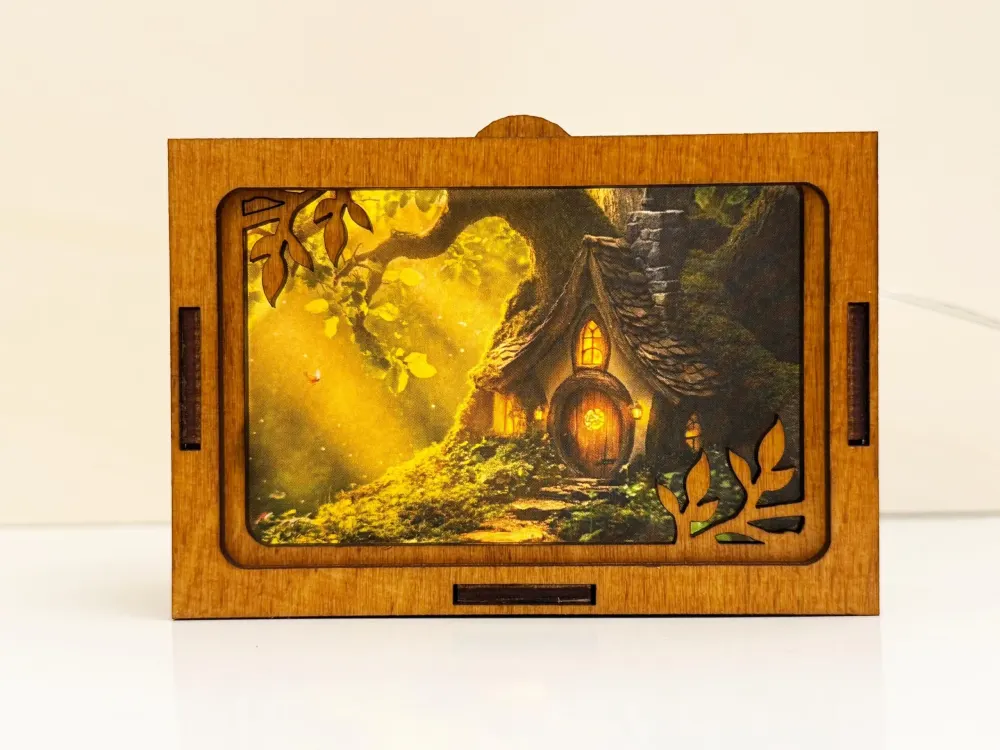
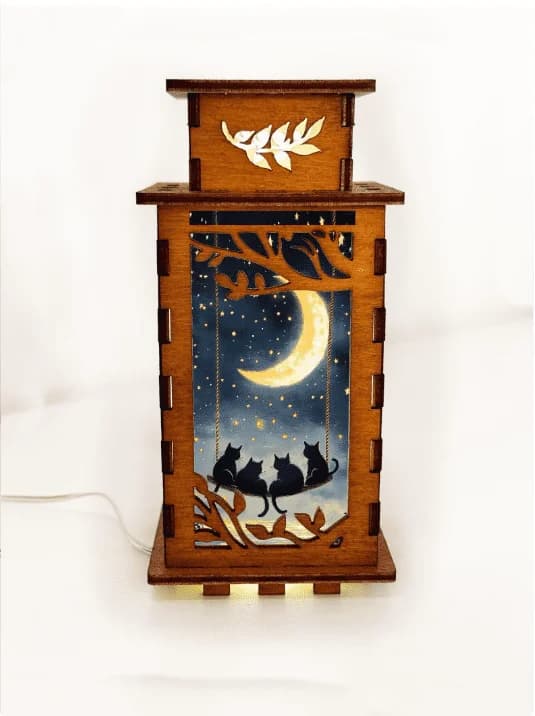
Instead of one flat panel, the scene is split into several thin layers stacked with small gaps. Light passes through the back layers first, so foreground shapes appear as silhouettes against a glowing background. The result has real depth and casts soft shadows, which is why these are sometimes called shadow-box lamps.
What can a laser not do?
A laser is precise but it is not a craftsman. It cannot:
- Judge whether a design will read clearly once lit
- Remove soot and fuzz from the faces (that is hand-sanding)
- Seal and protect the wood
- Line up the layers and fit the light
- Decide whether a lamp is good enough to send
Is laser-cut wood still handmade?
Yes, in the same way a woodworker using a bandsaw is still making by hand. The design is original, the machine is a cutting tool, and every step after cutting is manual. We compare this with mass-produced alternatives in handmade vs mass-produced wooden lamps, and show the studio itself on the atelier page.
How a layered wooden lamp is made
- 1
Design in layers
The scene is drawn as separate layers, from foreground (a window frame, a branch) to background (moon, sky).
- 2
Prepare the files
Each layer becomes a vector file that tells the laser exactly where to cut.
- 3
Laser-cut the wood
Each layer is cut from a thin sheet of natural wood; the beam leaves a darkened edge.
- 4
Sand by hand
Faces and edges are hand-sanded to remove soot and roughness.
- 5
Seal
The wood is sealed with a non-toxic finish to protect it.
- 6
Assemble and light
Layers are assembled around a warm white LED powered by 5V USB.
- 7
Inspect lit
Each lamp is checked with the light on before it is packed.
Featured Wooden Lamps
Frequently Asked Questions
How does laser cutting work on wood?
Direct Answer: A focused laser beam burns a very narrow line through the wood, following a digital design, which allows fine detail.
Is laser-cut wood safe?
Direct Answer: Yes. Once cut, sanded and sealed with a non-toxic finish, the wood is as safe as any finished wooden décor.
Are laser-cut lamps handmade?
Direct Answer: Yes. The laser is a cutting tool; design, sanding, finishing, assembly and inspection are done by hand.
Why are the edges of laser-cut wood dark?
Direct Answer: The heat of the beam lightly chars the edge. A little darkening outlines the shapes nicely when the lamp is lit.
Enjoy this guide? Add Artiviesta as a Preferred Source to see our studio guides and lamp releases in Google.